
When you have a small business, you most likely have heard the terms digital marketing and social media marketing used interchangeably. The agency websites are blurry. The freelancers package them. Course designers make them simplistic. However, in case you have a limited budget to invest in, you should know the distinction between digital marketing and social media marketing.
Confusion is unjustified in small enterprises. Every rupee, every hour and every campaign should produce quantifiable outcomes. By knowing the nature of the relationship between digital and social media marketing, although they act in different ways, you will make better decisions, develop more powerful funnels, and grow sustainably.
This guide will deconstruct digital marketing and social media marketing in detail, differentiate them strategically and show how both small businesses can maximise the impact using the two.
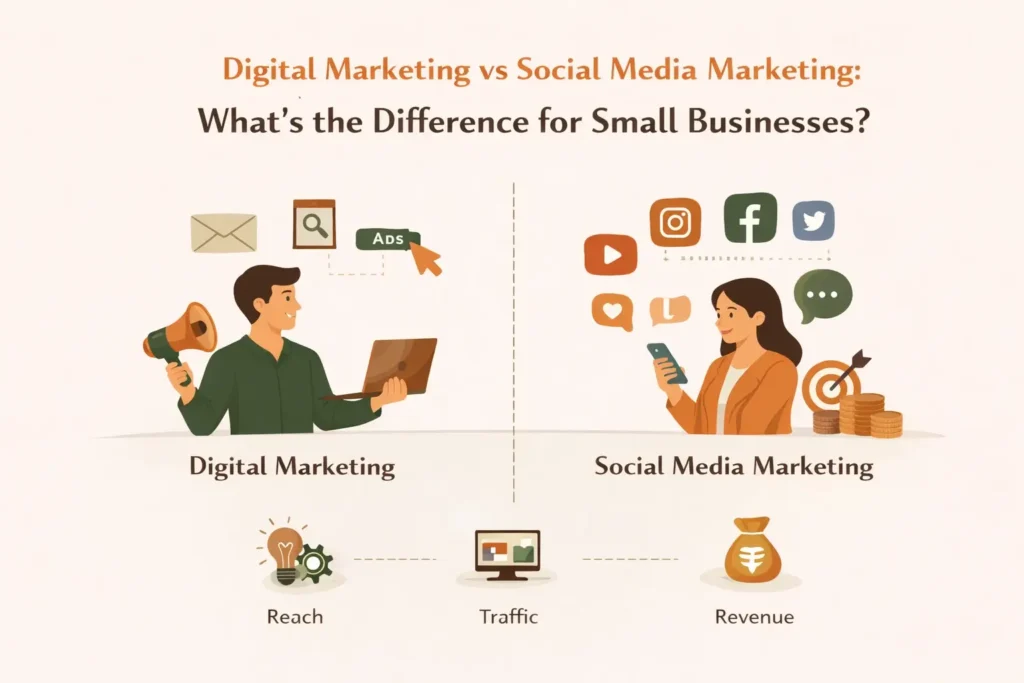
What Is Digital Marketing?
The entire marketing that involves the utilisation of digital means of marketing products or services is termed digital marketing. It encompasses all online plans to be used to attract, engage, convert, and retain customers.
Speaking about digital marketing and social media marketing, it is important to keep in mind that social media marketing is not the opposite of digital marketing; the latter is a subset of the former.
A typical digital marketing incorporates:
- Search Engine Optimisation (SEO)
- Pay-Per-Click Advertising (PPC)
- Content Marketing
- Email Marketing
- Affiliate Marketing
- Influencer Marketing
- Website Optimization
- Conversion Rate Optimisation
- Online Reputation Management
Search intent, website traffic, data tracking, automation, and the scalability of digital marketing have a lot of emphasis over the long run. It targets to develop predictable customer acquisition systems.
To give an example, when one types in a search query like best bakery near me and your site is listed on Google due to your search engine optimisation, that is digital marketing. Digital marketing would be running Google Ads based on keywords such as purchasing handmade candles online.
Digital marketing and social media marketing can be used interchangeably, although digital marketing is much more than the activity of posting on Instagram or Facebook.
What Is Social Media Marketing?
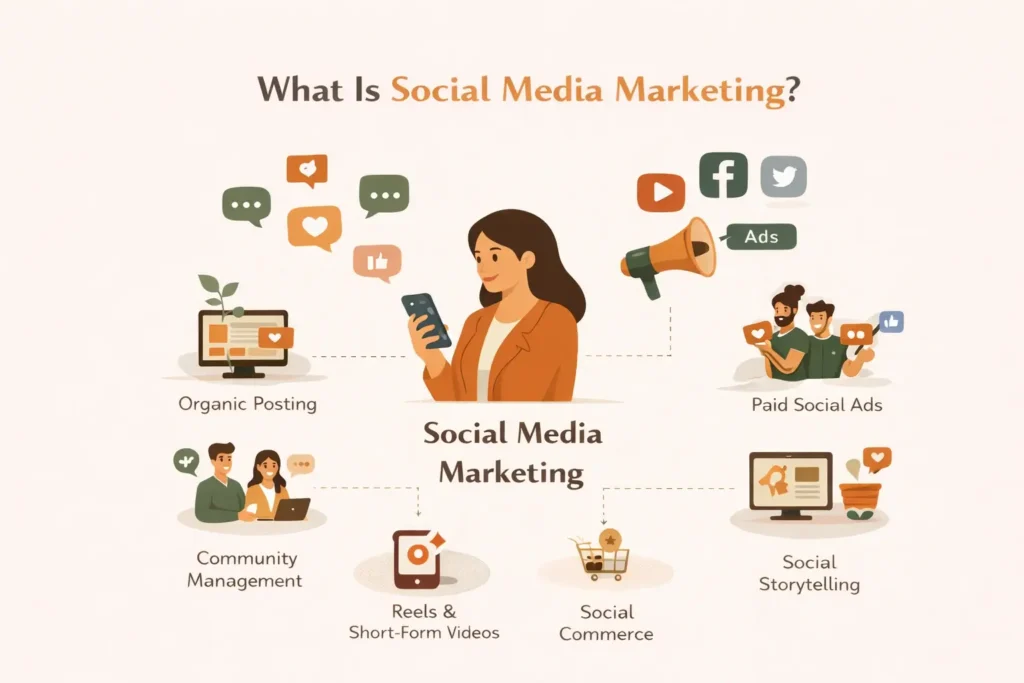
One of the specialised areas in digital marketing is social media marketing. It concentrates on leveraging only social media platforms to create brand awareness, target audiences and convert them.
It includes:
- Organic posting
- Community management
- Paid social ads
- Influencer collaborations
- Reels and short-form videos
- Social storytelling
- Social commerce
The most popular platforms are Instagram, Facebook, LinkedIn, YouTube, Pinterest, and X (formerly Twitter).
Indeed, when making a comparison between digital marketing and social media marketing, one should realise that the latter focuses on discussions and exposure within social networks. It feeds on the engagement metrics, including likes, comments, shares, saves and followers.
In the case of small businesses, social media marketing creates brand personality and trust. It humanises your brand. It enables you to present content behind the scenes, testimonials, educational posts, and interactive campaigns.
Nevertheless, social media marketing is not a panacea to ensure the stability of the traffic in the long run. Algorithms change. Organic reach drops. Trends shift quickly.
It is in this area that larger digital marketing plans are needed.
The Core Difference Between Digital Marketing and Social Media Marketing
The distinction between digital marketing and social media marketing is the difference in scope, purpose, and channel variety.
Online marketing is all-inclusive. It encompasses search engines, websites, emails, advertisements, analytics, automation and various other online platforms. Social media marketing is concerned with the social platforms only.
And now, let’s have a look at this strategically.
Digital marketing is concerned with demand capture. Marketing is based on the demand in social media.
When a customer types in plumber in Delhi, he or she has intent. SEO and Google Ads are aimed at that purpose. That’s digital marketing.
Social media marketing is when you share an interesting reel about how to maintain your house and create awareness.
Digital marketing is usually conversion-oriented. Social media marketing tends to be interaction-based.
The metrics of digital marketing are the lead, conversion, cost per acquisition and ROI. Social media marketing is gauged by the rate of engagement, reach, impressions, and the growth of the community.
The difference between digital marketing and social media marketing would help small businesses to spend their money in the right place and not just increase their posts without understanding.
Why Small Businesses Get Confused
Small businesses have a common belief that constant posting on Instagram is equal to full marketing. This misconception forms stalling stages.
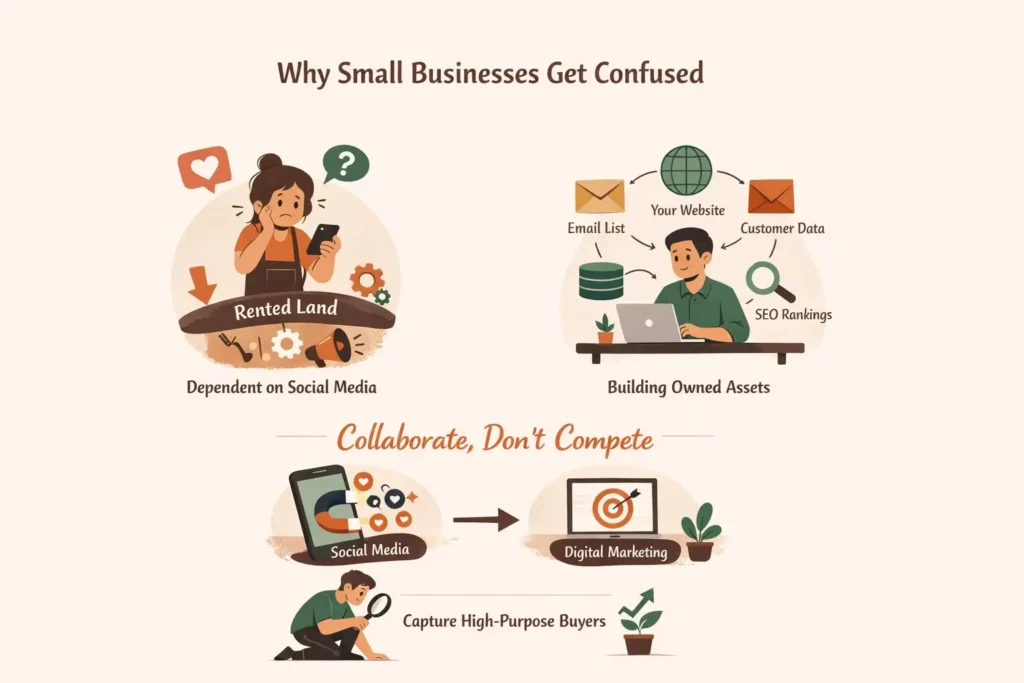
The ugly truth about this is that when your whole business is built on your social media marketing, you are putting your business on rented land. Platforms determine operations, exposure and outreach.
Digital marketing provides you with owned assets:
- Your website
- Your email list
- Your customer database
- Your SEO rankings
The use of social media marketing and digital marketing is to collaborate and not to compete. The attention goes to social media. Online marketing turns and keeps customers.
Without paying attention to SEO, content marketing, and optimisation of your website, you will be missing high-purpose buyers that are actively searching to find your solution.
Channels Included in Digital Marketing
To have a clear understanding of digital marketing and social media marketing, we will further subdivide digital marketing channels into bits.
Search Engine Optimisation (SEO)
SEO will assist in ranking your site. It focuses on organic traffic and develops sustainable authority. Consumers can refer to SEO content years after it was published, unlike social media posts that vanish after several hours.
Pay-Per-Click Advertising (PPC)
High-intent users are attracted through Google Ads and search ads. PPC is quicker than an organic strategy and will demand management of expenses and tracking skills.
Content Marketing
Blogs, directions, home pages, and downloadable materials generate traffic and enlighten customers. Good content enhances digital marketing as well as social media marketing.
Email Marketing
It fosters hot prospects, repeat buying and retention. Email ownership cannot be substituted with social ones.
Website Optimization
The key to the success of digital marketing lies in having a fast, mobile-friendly, conversion-oriented site.
In measuring digital marketing and social media marketing, bear in mind that social media is just a fraction of the bigger picture, the ecosystem.
Strengths of Social Media Marketing
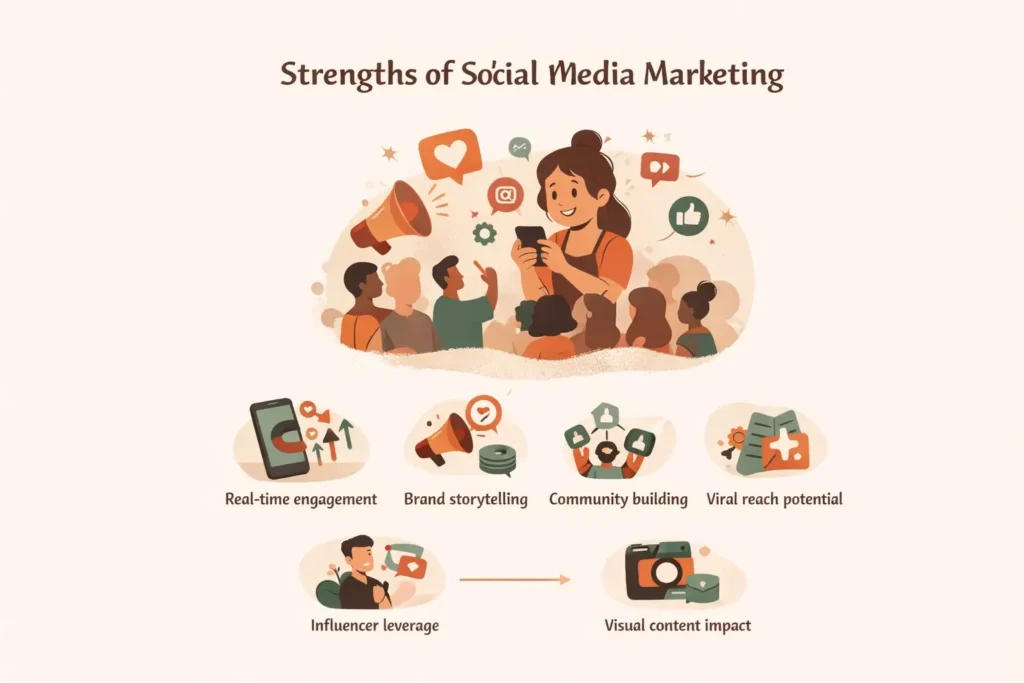
Though social media marketing is not so exhaustive as digital marketing, it has certain advantages:
- Real-time engagement
- Brand storytelling
- Community building
- Viral reach potential
- Influencer leverage
- Visual content impact
In the case of startups and local businesses, social media marketing develops a credible, immediate visibility.
Nevertheless, its exclusive use is unstable. Digital marketing and social media marketing should be combined with a structured approach to sustainable growth.
Strategic Comparison
We are not going to use a mere table, but rather, we are going to analyse strategically.
Digital marketing lays stress on search, automation, and funnelling. This is efficient with companies that have to generate leads predictably.
It is social media where interaction and brand awareness are stressed. It is effective with companies that are based on emotional appeal and visual appeal.
Digital marketing normally demands technical skills in SEO, analytics and conversion tracking. Social media marketing demands imagination, narration, and trend sensitivity.
When you consider metrics, the distinction between social media marketing and digital marketing is apparent.
Digital marketing measures cost per lead, organic ranking, the rate of click-through, and the rate of conversion.
The social media marketing measures the rate of engagement, the number of followers, and content coverage.
Both are important. However, understanding them in the wrong way contributes to an unmatched expectation.
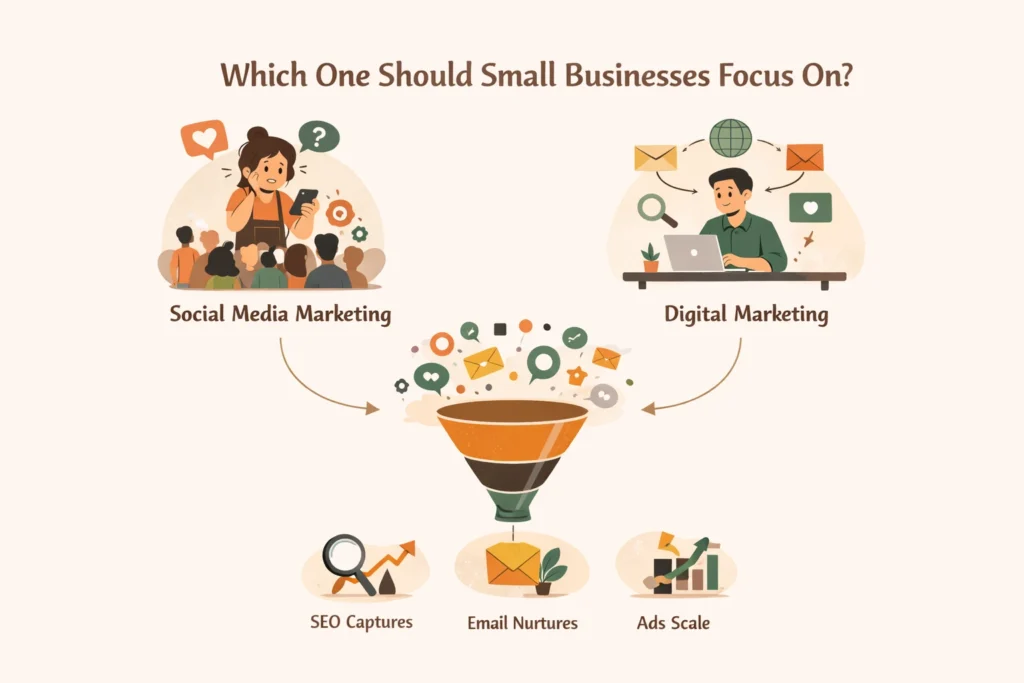
Which One Should Small Businesses Focus On?
The truth is neither here nor there. It depends on your stage.
Social media marketing can be used to create awareness within a short time when you are introducing a new brand with zero visibility.
Digital marketing is necessary if you desire long-term control and consistent lead generation.
The first step that a small business can take is to develop a professional site and make it searchable. They ought to then use social media marketing to attract traffic to that site.
Social media marketing and digital marketing should act as a funnel.
Social media attracts. SEO captures. Email nurtures. Ads scale.
Unless you follow the steps, you will suffer time loss.
Budget Allocation for Small Businesses
Let’s be practical.
When your budget every month is low in marketing, then spend it wisely:
- Invest in website and SEO foundations first.
- Use social media marketing consistently but strategically.
- Avoid random boosting of posts without funnel tracking.
- Track ROI through analytics tools.
Budget management also differs with regard to digital marketing and social media marketing. Social advertisements can have a brief effect, whereas SEO is cumulative.
The smart small businesses strike a balance between short-term and long-term development.
How to Integrate Digital Marketing and Social Media Marketing
The move to integrate is the actual power move.
Post search engine-optimised blogs using high-intent keywords. Thereafter, reuse that content in the form of social posts, reels, and carousels.
Move Instagram traffic to lead magnets. Capture emails. Send nurturing sequences.
Re-target visitors on social media with paid advertisements. Analyze behavior. Improve conversions.
Customer journeys are smooth when digital marketing and social media marketing are in sync.
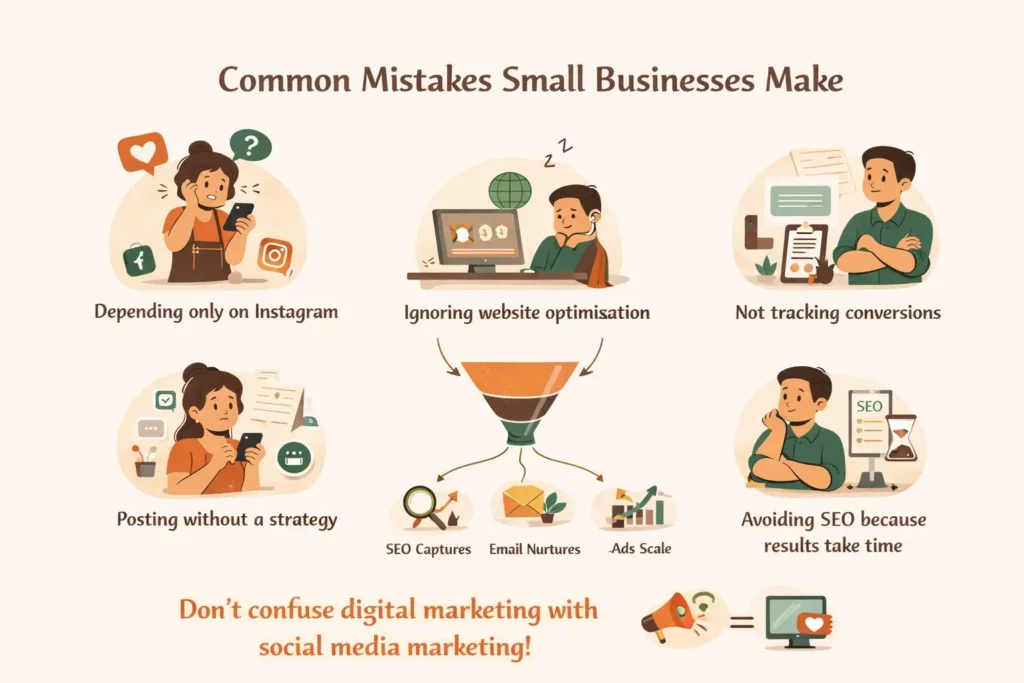
Common Mistakes Small Businesses Make
- Depending only on Instagram.
- Ignoring website optimisation.
- Not tracking conversions.
- Posting without a strategy.
- Avoiding SEO because results take time.
It is a mistake to equate digital marketing with social media marketing, as this understanding helps avoid such errors.
Long-Term Growth Perspective
Social media marketing provides quickness. There is stability with digital marketing.
Social media can make you go viral. Search engines assist in authority building.
You should invest in the assets that you own in case your small business is to survive the changes of the algorithm and platform bans.
Digital marketing should not be a rival to your budget.
The distinction between digital marketing and social media marketing is not a mere theory. It dictates the structure of your growth engine.
Final Thoughts
The small businesses that know about digital marketing receive a comparable advantage. They abandon their pursuit of vanity measures. They are concentrated on quantifiable growth.
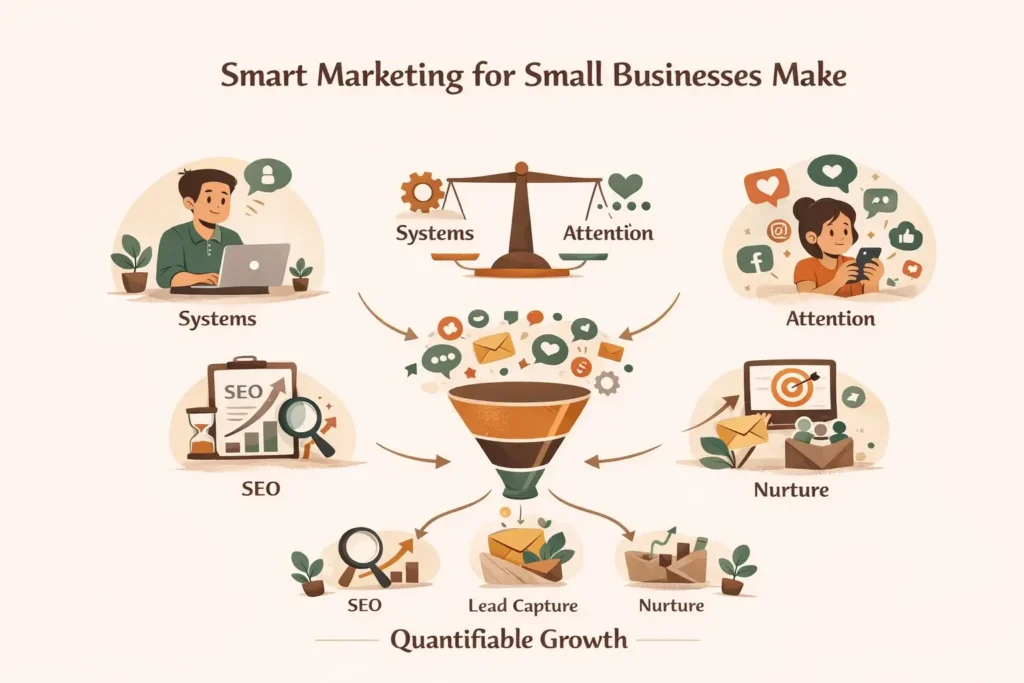
Online marketing develops systems. Attention is developed through social media marketing.
The systems-free attention dies. Attention is missing in systems.
When they work in a strategic manner, the actual growth occurs.
Social media is not a whole marketing strategy to take in order to be sustainable. Create your website, search engine optimisation, lead capture, nurture relationships and utilise the social sites as distribution channels.
As soon as you get the distinction between digital marketing and social media marketing right, you will cease to guess, but you will be developing a scalable marketing ecosystem that can support long-term profitability.
Smart marketing is non-trendy. It is concerning the organisation, readability and implementation.
Frequently Asked Questions (FAQs)
1. What is digital marketing?
Digital marketing includes all online marketing strategies such as SEO, Google Ads, email marketing, content marketing, and social media marketing.
2. What is social media marketing?
Social media marketing focuses only on promoting a business through platforms like Instagram, Facebook, LinkedIn, and YouTube.
3. What is the difference between digital marketing and social media marketing?
The difference between digital marketing and social media marketing is that digital marketing covers all online channels, while social media marketing is limited to social platforms.
4. Is social media marketing part of digital marketing?
Yes, social media marketing is a subset of digital marketing.
5. Which is better for small businesses?
Both digital marketing and social media marketing work best when used together strategically.
6. Does digital marketing require a website?
Yes, a website is essential for effective digital marketing and long-term growth.
7. Can social media marketing generate sales?
Yes, but it performs better when connected to a broader digital marketing funnel.
8. Which gives faster results?
Social media marketing can provide quicker visibility, while digital marketing offers long-term stability.
Stop guessing and start scaling—partner with Bean to Brand for influencer marketing that delivers real results.